
Industry Insights
Observations from the Doorstep, the Car Park Briefing, and the Slightly Damp Clipboard There are many varieties of sales leadership. There is the boardroom variety, which involves decks, pipelines, and a great deal of confident language about "accelerating revenue velocity." There is the inside sales variety, which takes place in open-plan offices and involves headsets. And then there is field sales leadership in door-to-door environments — charities, energy suppliers, telecoms — which involves none of these things and instead involves a seven-seat minibus, a postcode list, a team of eight people with wildly varying levels of enthusiasm, and the ambient challenge of British weather, which treats charity fundraisers and energy switchers with equal indifference.

The Future of Face-to-Face Sales in an AI World On Whether the Doorstep Has a Future, and What It Might Look Like If It Does Every few years, a technology arrives that is confidently described as the end of door-to-door sales. The internet was going to finish it. Comparison websites were going to make it redundant. Smartphone apps were going to render the clipboard obsolete. Each time, the obituary was written with some conviction, and each time, someone somewhere continued to knock on doors and sign people up for things, apparently undisturbed by the news of their own professional extinction.

On the Gradual Obsolescence of Finding Out Too Late. There is a management style in field sales that was, until relatively recently, entirely standard and is now merely common. It involves the sales leader receiving the previous day's results sometime in the mid-morning, reviewing them with a mixture of satisfaction and concern, and then making a series of decisions about the current day's operation that are based entirely on information that is between twelve and thirty-six hours old. Adjustments are made. Coaching conversations are scheduled. Territory reassignments are considered.

On the Elegant Business of Turning the Possibility of Winning £25 into a Functioning Hospice There is something quietly remarkable about the charity lottery model that tends to get lost in the administrative language surrounding it. At its core, it is an arrangement in which a large number of people agree to part with a modest sum of money each week or month, in full knowledge that the overwhelming statistical probability is that they will receive nothing whatsoever in return, and in which the aggregate of these transactions funds hospitals, hospices, conservation projects, food banks, research programmes, and an enormous range of other things that society has collectively decided are important but has not always collectively decided to pay for through taxation.

Turning Operational Data into Competitive Advantage On the Considerable Distance Between Having Data and Actually Using It There is a particular type of management meeting that occurs with reliable frequency in door-to-door sales operations, in charity lottery programmes, and in the field-based commercial teams of energy suppliers and telecoms companies. It is the meeting in which someone presents a dashboard. The dashboard contains numbers. The numbers are large, colourful, and arranged in a format that implies insight. Everyone around the table nods at the numbers with the focused expression of people who are extracting value from them.

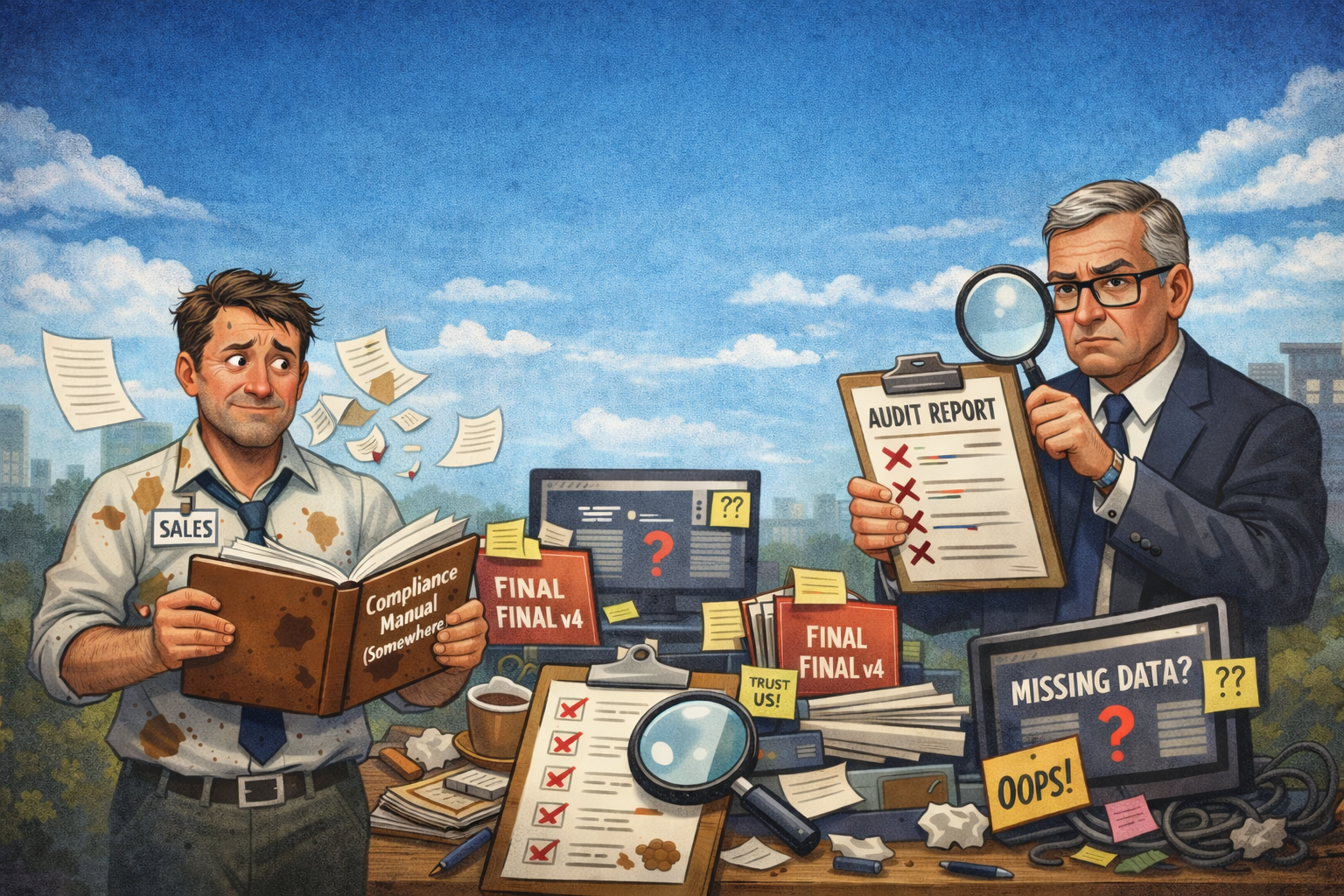
For many organisations running field sales operations, the phrase “compliance audit” has a curious effect on the atmosphere. The general expectation is that the audit will simply confirm what everyone already believes: that the operation is fundamentally sound, the rules are broadly followed, and any small irregularities are merely administrative details. Then the audit report arrives.
A Reasonably Honest Examination of What Actually Happens on the Doorstep There is a version of the door-to-door sales pitch that exists in training manuals and roleplay scenarios, in which a well-prepared agent delivers a structured presentation to an attentive prospect who considers the proposition on its merits, concludes that it represents genuine value, and makes a rational, informed decision to proceed. This version is, in the technical sense, possible. It is also, in the experiential sense of anyone who has spent time on or near a doorstep, not quite the whole story.

A Modest Catalogue of Avoidable Catastrophes There is a certain comfort, for the compliance professional, in knowing that however badly things are going at their own organisation, someone, somewhere, has done considerably worse. History is generous in this respect. The annals of corporate sales are littered with cautionary tales of such spectacular dimension that they almost — almost — inspire admiration for the sheer commitment involved. What follows is not an exhaustive list. It couldn't be. The subject matter is simply too abundant.

On the Considerable Expense of Assuming Everything Is Probably Fine There is a category of operational risk that is, in a specific sense, worse than the risks that organisations actively worry about. It is the risk that nobody is worrying about — not because it has been assessed and found acceptable, but because the assessment has not been done, the visibility does not exist, and the assumption that things are probably fine has been allowed to harden, through repetition and the absence of immediate consequences, into something resembling a compliance strategy.

On the Underappreciated Science of Sending People to the Right Street There is a school of thought in door-to-door sales management that territory planning is, essentially, a matter of pointing at a map and saying "that bit." The postcode exists, the houses are in it, and the agents are presumably capable of walking from one end of a street to the other without significant navigational assistance. What more, the thinking goes, is there to it?