
The 6 Step Structured Process
Lifecycle of a Field Agent
BraynBox Structures the Entire Agent Lifecycle
From recruitment and certification to activation for live campaigns.
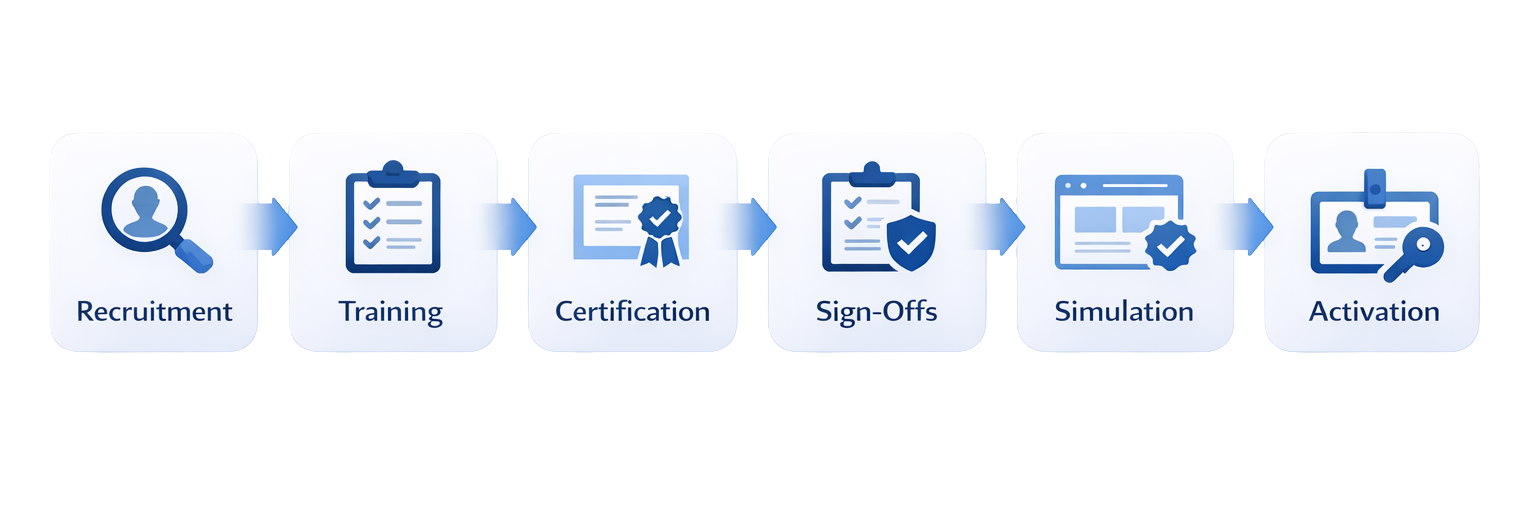
1
Recruitment
Prospective agents are identified and onboarded through structured recruitment workflows.
Candidate details, documentation, and eligibility information are captured before progressing further in the lifecycle.
Identity is not assumed.
It is governed.
2
Training
Agents complete onboarding and training that introduces campaign requirements, operational processes, and compliance expectations.
Ensures agents understand how the campaign operates before moving to certification.
Training is not distributed.
It is enforced.
3
Certification
Agents must successfully pass knowledge certification to confirm their understanding of campaign rules and regulatory obligations.
Only qualified agents progress to the next stage of the lifecycle.
No certification results in no progression.
Competency is measured — not declared.
4
Sign-Offs
Campaign rules, regulatory declarations, and operational approvals are confirmed before agents are permitted to proceed.
This step ensures all compliance requirements are acknowledged and documented prior to deployment.
Compliance is not implied.
It is structured and recorded.
5
Simulation
Agents complete simulated workflows within the platform to demonstrate their ability to perform the registration process correctly.
This stage validates operational readiness before agents interact with real supporters.
Readiness is verified through execution.
6
Activation
Once all stages are completed, authorised agents receive secure platform credentials.
Agents are then activated to begin live field campaigns.
Access is conditional. Activation is authorised.
Authorisation is defensible.
Continuous Governance After Activation
Activation does not conclude governance. It initiates controlled execution.
Once authorised, access is precisely scoped and dynamically permissioned. Agents operate under role-based permissions aligned to their validated campaign, authorised geography, and defined operational remit.
Device registration and territory allocation are formally bound to the agent profile within the governed architecture.
Access is never generic.
It is structured, conditional, and enforceable.
Governance remains continuous. Should certification expire, compliance documentation be updated, identity validation lapse, or risk indicators be triggered, system permissions are automatically restricted or suspended in accordance with configured control logic.
Operational access is therefore not a one-time grant. It is a sustained state of validated compliance.
Authorisation is earned through structured progression.
Operational authority is deliberately provisioned.
Every permission remains time-stamped, attributable, and audit-traceable within the lifecycle framework.
Sector-Specific Compliance
Each regulated sector has unique compliance requirements. BraynBox includes sector-specific workflows aligned to regulatory standards.
Charity & Lottery
Fundraising Regulator standards
- Fundraising Regulator standards
- Gambling Commission requirements
- Data protection (GDPR)
- Vulnerable person safeguarding
- Site authorization tracking
- Age verification workflows
Energy Efficiency
ECO scheme aligned
- ECO scheme requirements
- Grant eligibility verification
- Technical standards
- Installation compliance
- Consumer protection measures
- Post-installation quality checks
Energy & Utilities
Ofgem-compliant workflows
- Cooling-off period management
- Standards of conduct workflows
- Vulnerability safeguards
- Customer consent requirements
- Erroneous transfer prevention
- Contract term clarity
Telecoms
Standards of conduct
- Service availability verification
- Contract term clarity
- Cooling-off period compliance
- Fair treatment standards
- Switching process safeguards
Dedicated Apps
The BraynBox platform delivers its governed lifecycle through two dedicated, purpose-built APPs — each designed to support distinct stages of recruitment, activation, compliance, and live field execution.
Together, they operate as a unified operational framework rather than standalone tools.